

『Insertion Type Water Flow Meter: Hot-Tapping Pressurized Water Mains without Plant Shutdown Failures』Related information(v cone flow meter|rotary gas meter|gallon meter|gear meter|metal tube rotameter|glass tube rotameter|nutating disk meter|transit time ultrasonic flow meter|wedge flow meter|pd meters|hydraulic flow meter|ultrasonic water flow meter|water flow meter|air flow meter|magnetic water flow meter|oxygen flow meter|gas flow meter|argon flow meter|air velocity meter|gasoline flow meter|fuel flow meter|ultrasonic water meter|digital water meter|nitrogen flow meter|solid flow meter|Oxygen tank flow meter|digital water flow meter|diesel fuel flow meter|steam flow meter|02 flow meter|compressed air flow meter|oil flow meter|liquid flow meter)
Insertion Type Water Flow Meter: Hot-Tapping Pressurized Water Mains Without Plant Shutdown Failures
Quick Answer: Insertion type water flow meters with hot-tap kits allow flow measurement on pressurized water mains without draining the line or stopping production. A correctly installed insertion electromagnetic model gives you 1.0 to 2.0 percent of reading accuracy and a 4-20 mA HART output. Send us your pipe size (DN), pressure (bar), temperature (°C), and flow range for a hot-tap insertion meter quote from Silver Automation Instruments.
How Hot-Tap Insertion Works on Pressurized Water Mains
An insertion type water flow meter does not need a full pipe spool. The sensor enters the pipe through a hot-tap saddle and a full-bore ball valve. You weld or clamp the saddle onto the live main. A hot-tap machine drills the pipe under pressure. The ball valve holds pressure while you remove the drill and insert the sensor. You then push the sensor to the required depth and lock the seal. This method is common on DN80 to DN1200 water mains at pressures up to 16 bar.
In practice, many plants choose hot-tap insertion meters because shutdown costs are higher than the meter price. A water utility in Vietnam installed a hot-tap insertion electromagnetic meter on a DN300 cement-lined ductile iron main at 7 bar. The installation took less than four hours and the line stayed in service the whole time.
Typical Accuracy and Output Data
Insertion electromagnetic flow meters from Silver Automation Instruments measure velocity from 0.1 m/s to 10 m/s. Accuracy is typically 1.0 to 2.0 percent of reading when the insertion depth is correct and the straight run is adequate. Repeatability is 0.2 percent. The transmitter supplies a 4-20 mA HART signal, RS485 Modbus, and a pulse output. Power options include 24 V DC and 85 to 265 V AC. Sensor protection is IP68 and the transmitter is IP67. These meters handle water temperature from 0 to 80 °C as standard.
For clean water, a standard 316L electrode sensor works well. For wastewater with grease or solids, ask for a rugged tip and a longer insertion stem. We have seen a paint manufacturer in Southeast Asia use an insertion electromagnetic meter on a DN150 cooling water line with 4-20 mA HART input to a PLC. They wanted no shutdown and a simple two-wire loop. That setup has worked for over two years without drift.
What Causes Hot-Tap Insertion Flow Meter Failures
Most hot-tap insertion flow meter failures on pressurized water mains come from a few site conditions. Wrong insertion depth is the most common cause. If the sensor tip is not at the center or the correct average velocity point, the reading shifts. Many installers skip the depth calculation based on pipe ID and wall thickness. This produces a repeatable but wrong flow rate.
Damaged seals and O-rings come second. A hot-tap insertion meter uses gland packing or compression seals to hold pressure. If the pipe has grit, the seal can score and leak. The correct move is to flush the saddle and use the seal kit supplied by the manufacturer. Never reuse an old O-ring after a retraction.
Short straight runs cause unstable readings. We recommend 10D upstream and 5D downstream for insertion meters. If a valve, pump, or elbow sits too close, the flow profile is skewed. The meter sees a distorted velocity pattern and the output jumps. Air bubbles and large solids can also spike the signal on electromagnetic sensors.
Correct Hot-Tap Installation Without Plant Shutdown
Use a hot-tap kit rated for your line pressure. For a 10 bar water main, the saddle, ball valve, and drill must be rated at 10 bar minimum. For a 16 bar line, use 16 bar components. The hot-tap machine needs a safe pressure boundary. Operators should follow plant lockout rules even when the line stays live.
First, confirm the pipe material and wall thickness. A clamp-on saddle works for steel, ductile iron, and some PVC mains. For concrete or old asbestos cement, you may need a special saddle or a full pipe section. Next, calculate the insertion depth. For insertion electromagnetic meters, the electrode tip should sit at 1/8 to 1/2 of the pipe inner diameter depend
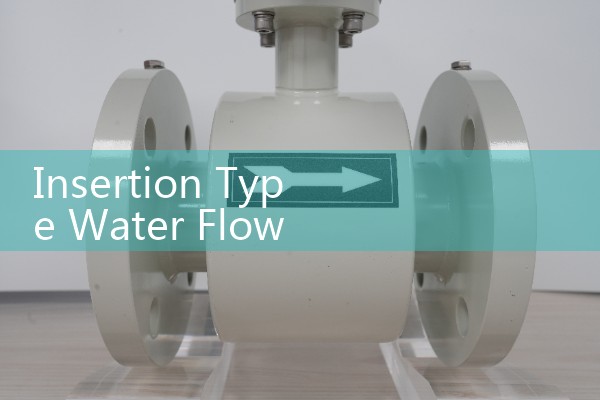
After drilling, retract the drill carefully and close the ball valve. Insert the sensor stem through the valve and tighten the compression fitting. Then open the valve and push the sensor to the calculated depth. Lock the depth with the provided hardware. Check for leaks before connecting the transmitter.
Recommended Insertion Flow Meters for Water Mains
Silver Automation Instruments recommends the insertion electromagnetic flow meter for conductive water applications such as potable water, cooling water, raw water, and treated wastewater. The sensor body is 316L stainless steel and the sensor tip is PVDF or PTFE. The converter gives you local indication, 4-20 mA HART, RS485 Modbus, and a pulse output. Pipe sizes range from DN50 to DN2000. For large mains above DN2000, we provide a custom insertion length.
For non-conductive fluids or temporary measurement, we offer an insertion ultrasonic flow meter. This model works on clean water and some wastewater lines. It uses a paired transducer set and can be installed with a hot-tap kit on steel or ductile iron mains. Accuracy is 1.0 to 2.0 percent of reading with a fully developed flow profile.
Here is the thing. If your water has conductivity above 20 µS/cm, select the insertion electromagnetic meter. If the water is demineralized or you need a clamp-on reference, the ultrasonic model is better. Most engineers skip this part and then wonder why the signal is unstable.
How to Specify a Hot-Tap Meter for Your Water Main
To get a quote, send Silver Automation Instruments the following data. Pipe inner diameter (DN), pipe outer diameter and wall thickness, pipe material, water pressure (bar), water temperature (°C), normal and maximum flow rate, and required output. Also tell us if the installation is indoors or outdoors and if you need ATEX Zone 1 or FM approval.
We have supplied hot-tap insertion water flow meters to contractors in Malaysia, Saudi Arabia, Chile, and Nigeria. Each order is different because the pipe schedule and saddle style are not the same everywhere. A customer in Lagos needed a hot-tap meter for a DN400 steel main at 12 bar. The order included a 316 stainless steel saddle, a full-bore ball valve, a hot-tap drill adapter, and an insertion electromagnetic meter with a 4-20 mA HART transmitter. The total lead time was 8 days.
FAQ: Insertion Type Water Flow Meter Hot-Tapping
Can I install an insertion flow meter on a live water main without shutdown?
Yes. Use a hot-tap saddle and a full-bore ball valve. The line stays pressurized while you drill and insert the sensor. Stay within the pressure rating of the hot-tap kit.
What is the minimum straight run for an insertion type water flow meter?
Use 10D upstream and 5D downstream as a starting point. Avoid elbows, valves, pumps, or tees within this distance. If space is tight, contact Silver Automation Instruments for a flow conditioner or a custom calibration factor.
Which insertion meter is better for drinking water?
Use an insertion electromagnetic flow meter with 316L electrodes and potable water approvals. It has no moving parts and gives a stable 4-20 mA HART signal. For non-conductive or ultrapure water, choose an insertion ultrasonic model.
What are the main causes of hot-tap insertion flow meter failure?
Wrong insertion depth, damaged O-rings, short straight runs, air bubbles, and poor electrical grounding. A proper depth calculation and a clean saddle surface prevent most of these issues.
How much does a hot-tap insertion water flow meter cost?
Price depends on pipe size, pressure rating, saddle material, and transmitter features. Send us your pipe size (DN), pressure (bar), temperature (°C), and flow range. We will reply with a complete quote and delivery time.
Contact Silver Automation Instruments for hot-tap insertion water flow meters. Tel: +86-25-68650347. WhatsApp: +86-25-52155837. WeChat: +86 15365082610. You can also visit flow-meter.com.au for industrial flow meter specifications.
 Hot News
 Related AD