

『How Flow Meter Works: Harnesses mechanical, magnetic, thermal, or acoustic interactions to measure structural fluid movement speeds.』Related information(v cone flow meter|rotary gas meter|gallon meter|gear meter|metal tube rotameter|glass tube rotameter|nutating disk meter|transit time ultrasonic flow meter|wedge flow meter|pd meters|hydraulic flow meter|ultrasonic water flow meter|water flow meter|air flow meter|magnetic water flow meter|oxygen flow meter|gas flow meter|argon flow meter|air velocity meter|gasoline flow meter|fuel flow meter|ultrasonic water meter|digital water meter|nitrogen flow meter|solid flow meter|Oxygen tank flow meter|digital water flow meter|diesel fuel flow meter|steam flow meter|02 flow meter|compressed air flow meter|oil flow meter|liquid flow meter)
How a Flow Meter Works and How to Specify the Right One
Quick Answer: A flow meter measures flow velocity through mechanical, magnetic, thermal, or acoustic interactions and turns that physical change into a readable flow signal. The correct meter depends on fluid, pipe size, pressure, temperature, and flow range. Silver Automation Instruments supplies the main flow meter types for water, oil, gas, steam, chemical, and food lines.
What Happens Inside a Flow Meter
A flow meter does one basic job. It converts fluid movement into an electrical or mechanical output. In many plants, this output is 4-20 mA HART, pulse, or RS485. The four common working principles are mechanical, magnetic, thermal, and acoustic.
Mechanical flow meters use moving parts. An oval gear flow meter traps a fixed volume between two gears. Each gear turn represents a known volume. This principle works well for diesel, fuel oil, and high viscosity liquids. For heavy fuel oil at 380 cP and 25 °C, an oval gear meter gives a stable pulse output.
Electromagnetic flow meters are different. They need a conductive liquid. Water, wastewater, acids, and slurries work well. The meter creates a magnetic field. Electrodes measure voltage generated by the moving fluid. Conductivity should be above 5 µS/cm in most cases. Demineralized water may need a special model. There are no moving parts in the flow path. Because of this, pressure loss is low and maintenance is simple.
Ultrasonic flow meters rely on sound. A transducer sends a signal through the fluid. Another transducer receives it. Flow changes the travel time. Clamp-on versions can be installed without cutting the pipe. This is useful for large cooling water lines and retrofits.
Thermal mass flow meters use heat. One sensor is heated and one sensor measures the process temperature. Gas flow cools the heated sensor. The cooling rate is used to calculate mass flow. A PT100 reference sensor is standard in many thermal mass meters. This works for compressed air, natural gas, and digester gas.
Coriolis mass flow meters measure mass directly. Fluid moves through vibrating tubes. The meter reads phase shift caused by mass flow. This principle also measures density. A DN15 Coriolis meter handles 0 to 600 kg/h for additive injection. It is common in chemical dosing, batching, and food and beverage production.
Why the Working Principle Matters in the Real World
Most engineers skip this part. They buy a flow meter based on price alone. Then the meter fails on a difficult fluid. We have seen this on customer sites many times. The principle matters because not every meter handles every fluid.
A paint manufacturer in Southeast Asia ordered a low cost turbine meter for a solvent line. The solvent was not conductive and had low viscosity. The turbine meter gave unstable readings. We replaced it with an oval gear flow meter. The batch totals became repeatable. The issue was not the brand. It was the wrong working principle.
So before you ask for a price, check the fluid properties. For conductive water and wastewater, an electromagnetic flow meter is often the best fit. For steam, a vortex flow meter works well. For compressed air, use a thermal mass flow meter. For diesel or fuel oil, use an oval gear flow meter. For high accuracy chemical batching, use a Coriolis mass flow meter. For a large pipe retrofit, a clamp-on ultrasonic flow meter saves installation time.
Flow Meter Types and Common Applications
Electromagnetic flow meters from Silver Automation Instruments are used for raw water, treated water, sludge, and chemical slurries. Sizes start at DN10 and go up to DN2000. Liners include PTFE, rubber, and polyurethane. Electrodes include 316L, Hastelloy, titanium, and tantalum.
Coriolis mass flow meters are supplied for molasses, syrups, polymers, and custody transfer. They read kg/h and density in one device. Output options include 4-20 mA HART, pulse, and
_600x400.jpg)
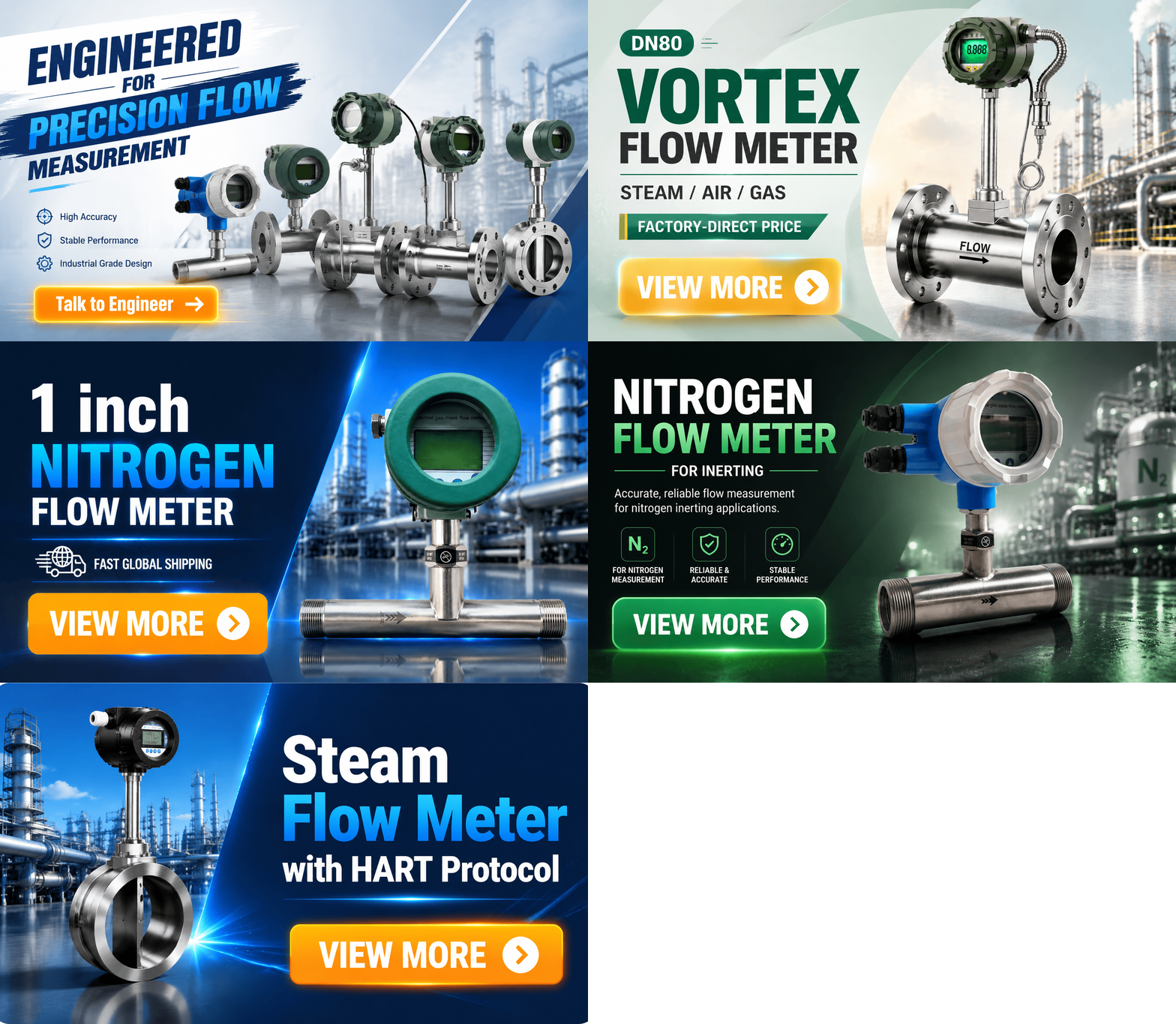
Vortex flow meters handle saturated steam, superheated steam, and clean gases. For a gas line in ATEX Zone 1, we supply Ex d or Ex ia versions. They are used in palm oil mills, textile plants, and food processing. Installation requires enough straight pipe. Pressure and temperature limits depend on the body material.
Oval gear flow meters are common for diesel, fuel oil, and lubrication oil. They handle flow as low as 0.1 L/min depending on size. A mechanical register or pulse output can be selected.
Thermal mass flow meters are used for compressed air systems, boiler gas lines, and biogas. They do not need pressure and temperature compensation for mass flow reading.
Clamp-on ultrasonic flow meters are used where pipe shutdown is not possible. They work on clean to lightly dirty liquids. A wastewater line with heavy solids needs a different meter.
What to Send for a Fast Flow Meter Quote
Here is the thing. A good quotation is only as strong as the data you provide. In practice, we ask for fluid name, flow range, pipe size, pressure in bar, temperature in °C, and power supply. We also ask for output signal and accuracy class.
For example, a desalination plant in the Middle East sent us this request. Seawater, DN200, 150 m3/h, 30 bar, 25 °C, 4-20 mA HART. We quoted an electromagnetic flow meter with PTFE liner and titanium electrodes. The customer received a fixed price and lead time in one day.
If you do not know the exact viscosity, tell us the fluid and temperature. We can check the meter sizing for you. For gas, send us the normal and maximum flow in Nm3/h or kg/h. For steam, send us the pressure and temperature because density changes a lot.
Why Buy from Silver Automation Instruments
Silver Automation Instruments is a flow meter manufacturer and supplier based in China. We serve small and medium industrial companies in Southeast Asia, Oceania, Latin America, Africa, and the Middle East. Many of our customers have 10 to 100 employees and need direct technical support.
We provide English manuals, inspection reports, and selectable outputs. Common signals are 4-20 mA HART, pulse, RS485, and Modbus. We supply flow meters for water and wastewater, oil and gas, chemical, food and beverage, and marine services.
We do not sell one principle for every job. We match the flow meter working principle to your process. This matters for repeatability, maintenance cost, and total ownership.
Flow Meter Working Principle FAQ
How does a flow meter work in simple terms?
A flow meter reads a physical change caused by fluid movement. It converts that change into a flow rate or total flow. The change may be mechanical, magnetic, thermal, or acoustic.
Which flow meter is best for wastewater?
An electromagnetic flow meter is usually best. It handles conductive dirty water and sludge. Choose the liner and electrode based on solids and chemical content.
Can one flow meter handle both gas and liquid?
Most flow meters cannot. Some vortex meters can switch between steam, gas, and clean liquid if configured. For fuel oil or compressed air, use a dedicated meter.
What details do you need for a fast quotation?
Send us fluid name, flow range, pipe size in DN, pressure in bar, temperature in °C, and power supply. We also ask for output signal and accuracy class.
Do you sell to small distributors and end users outside China?
Yes. Silver Instruments ships to Southeast Asia, Oceania, Latin America, Africa, and the Middle East. We support English documentation and after sales advice.
Request a Specific Flow Meter Quote
Send us your pressure (bar), temperature (°C), pipe size (DN), and flow range. Tell us the fluid and the country. We will recommend a flow meter and send a price.
Tel: +86-25-68650347
WhatsApp: +86-25-52155837
WeChat: +86 15365082610
Website: https://flow-meter.com.au
 Hot Blog
 Related AD